M-EDGE Network: Prime Integrator for a Resilient Multi-Vendor 5G Core
How M-EDGE acted as prime integrator — deployment, integration and core network support — to enable Telenor’s distributed 5G SA architecture all the way to Svalbard.
The Use Case
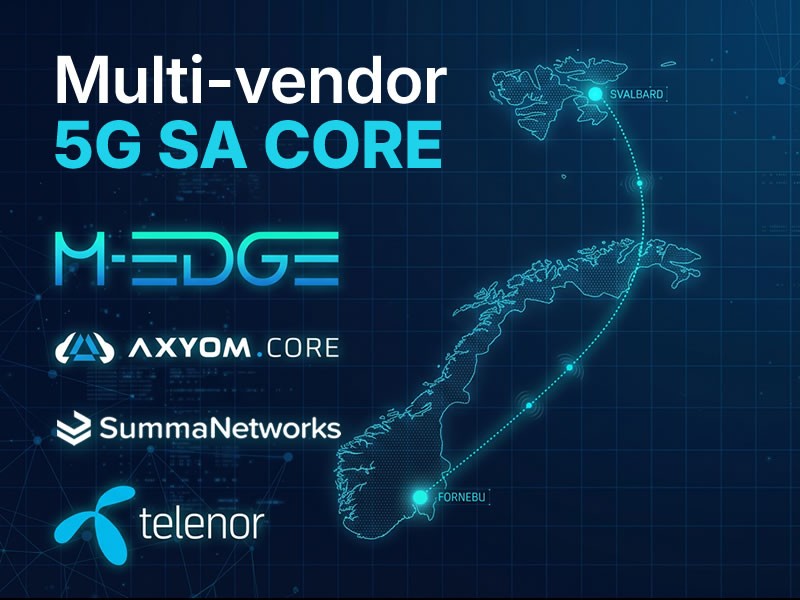
Svalbard is one of the most remote inhabited places on Earth, linked to mainland Norway by a long-distance connection that can be disrupted by weather, distance, and infrastructure incidents. Keeping the local community reliably connected called for an innovative approach to network design. At Telenor’s request, M-EDGE Network step in partnering with Telenor Research & Innovation to design, deploy, and demonstrate it: an autonomous local core network at the edge, able to keep serving the site on its own if the link to the mainland goes down. It’s an innovative, state-of-the-art architecture, with AxyomCore’s and Summa Networks’ technology as the foundation that supports it and built to support exactly this kind of use case.

Deploying a distributed, resilient 5G core network rarely relies on a single vendor. It requires a chain of technology partners — a core network vendor, a subscriber data management vendor and radio equipment vendors, that must work together consistently and reliably over time. On this project, a multi-vendor 5G Standalone (SA) core built around a central site in Fornebu and an autonomous edge site in Svalbard, M-EDGE Network acted as an integrator for the core network layer.
~2,000 km
between the central site in Fornebu and the edge site in Svalbard
2 phases
POC in Oslo/Fornebu, followed by deployment in Svalbard
Prime integrator
deployment, integration & core network support for AxyomCore and Summa Networks
Multi-vendor 5G SA
SBA architecture deployed on Red Hat OpenShift
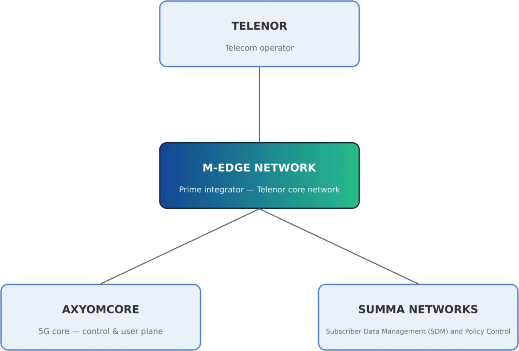
Prime Integrator for Telenor’s Core Network
On this project, M-EDGE acted as prime integrator for the core network layer, coordinating the two core vendors’ solutions — AxyomCore, which provides the 5G core control-plane and user-plane functions, and Summa Networks, which provides the Subscriber Data Management (SDM) and Policy Control functions. M-EDGE aligned the technical requirements of both vendors, resolved integration issues between their solutions, and remains the first point of contact for support and troubleshooting at the core network level — on top of the Red Hat OpenShift platform and integrated with a multi-vendor RAN environment spanning the Fornebu and Svalbard sites.
AxyomCore’s solution, with its separation of control and user plane, is the technical foundation that makes the 5G SA core and the autonomous edge architecture possible. M-EDGE’s role was to integrate that foundation into a deployed, supported, multi-vendor solution for Telenor.
Deploying and Integrating AxyomCore and Summa Networks
A central part of M-EDGE’s work focused on deploying AxyomCore’s control-plane and user-plane functions on the Red Hat OpenShift platform — with AxyomCore’s support on architecture, deployment and troubleshooting — and integrating them with Summa Networks’ Subscriber Data Management and Policy Control functions, aligning both with the rest of the network architecture (SBA), and validating the whole across the project’s two phases.
- Phase 1 — Proof of concept (POC) in Oslo/Fornebu, to validate the primary core network and the AxyomCore / Summa Networks integration.
- Phase 2 — Deployment in Svalbard, establishing an autonomous edge site synchronized with the primary site.
This integration work required verifying compatibility between the network functions exposed by each vendor — AMF, SMF, NRF, NSSF and UPF from AxyomCore, and UDM, UDR, AUSF and PCF from Summa Networks — and Telenor’s operational requirements, while ensuring the deployment remained compliant with 5G SA architecture standards and compatible with the multi-vendor ecosystem already in place on the RAN side.
Beyond the initial rollout, M-EDGE also owns ongoing support and troubleshooting at the core network level for both vendors’ solutions.
How the Autonomous Edge Works
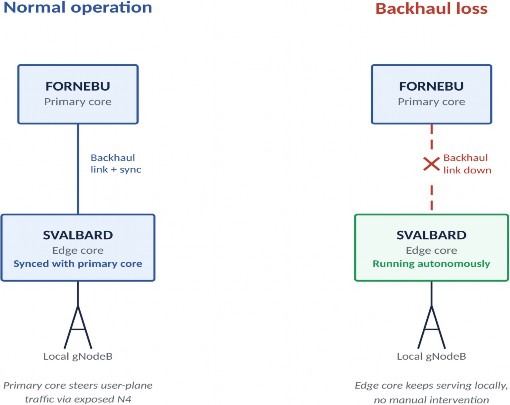
The Svalbard site runs its own local instance of the core network. When the backhaul link is up, traffic breaks out locally (LBO) instead of being routed all the way to the central site in Fornebu, keeping latency low for on-site services. If that link goes down, the edge core simply keeps operating on its own functions, with no manual intervention — local voice, data, and mission-critical services stay up regardless of the connection to the mainland.
Contributing to a High-Value Use Case
This work is part of a broader goal: giving Telenor a remote site that keeps operating on its own when connectivity to the central network drops. As prime integrator for AxyomCore and Summa Networks, M-EDGE Network helped turn that resilience requirement into a working solution — while letting Telenor retain technology flexibility, without depending on a single vendor for the entire chain, and ensuring consistent operations from the central site to the network’s most remote edge.
Results & Key Outcomes
- A working multi-vendor 5G SA core, validated in both environments, Fornebu and Svalbard.
- Backhaul-loss scenarios tested through simulation: once the link was cut, UEs reconnected quickly to the local Svalbard core.
- A validated integration path across two vendors — AxyomCore and Summa Networks — proven end-to-end from the Fornebu lab through to the autonomous Svalbard edge.
M-EDGE Network — Prime integrator: deployment, integration, and core network support for multi-vendor 5G networks.