Mobile Network Evolution: Why One Roadmap Doesn’t Fit Every Operator
Mobile network evolution doesn’t follow a single path. Discover why operators need the flexibility to evolve their Core across generations based on their own network strategy and timeline.
Technology doesn’t stand still.
New standards emerge. New network functions become available. New generations promise new possibilities.
But mobile network evolution doesn’t happen at the same pace for everyone.
While some operators are preparing for 5G Standalone, others are still modernising existing infrastructure, expanding 4G services or managing networks that span multiple generations.
There is no single starting point.
And there shouldn’t be a single roadmap.
The challenge for operators isn’t simply deciding what technology comes next. It’s deciding when and how to introduce it in a way that makes sense for their network, their customers and their business.
What does mobile network evolution look like today?
Mobile networks rarely move from one generation to another overnight.
In reality, network evolution is often a process of coexistence.
Legacy technologies continue supporting existing subscribers and services while newer technologies are gradually introduced. Different parts of the network may evolve at different times. And the priorities of one operator can be very different from those of another.
That means mobile network evolution is not simply a linear progression from one generation to the next.
It’s a series of architectural and business decisions.
Which technologies should be introduced?
Which existing services still need to be supported?
Which network functions need to change?
And, perhaps most importantly, when does each step make sense?
Different networks, different starting points
No two operators face exactly the same situation.
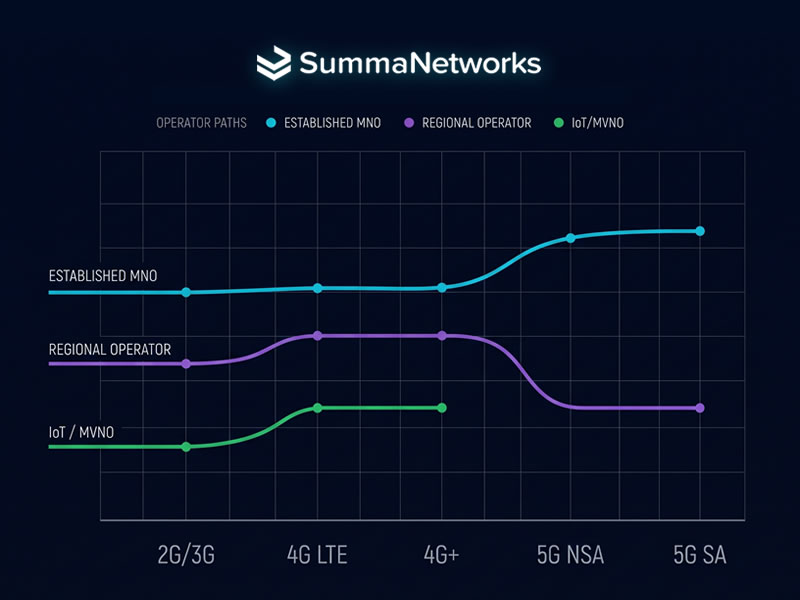
An established mobile operator may be managing infrastructure across several generations while planning its next steps. A regional operator may have different priorities from a large national network. An IoT provider may focus on specific functions rather than following the same technology path as a traditional mobile operator.
Their starting points are different.
Their requirements are different.
Their timelines are different.
So why should they all be expected to follow the same technology roadmap?
A Core architecture should give operators the flexibility to make decisions based on their own requirements rather than forcing them into a predefined migration path.
Why mobile network evolution shouldn’t follow a fixed roadmap
Technology roadmaps are useful.
But a vendor’s roadmap shouldn’t automatically become an operator’s roadmap.
The availability of a new technology doesn’t necessarily mean every network needs to deploy it immediately.
Operators need to consider their existing infrastructure, subscriber base, services, investment priorities and long-term strategy.
For some, the next step may be introducing new 5G functions.
For others, it may mean strengthening or modernising existing services.
And in many cases, the answer isn’t a single transition at all, but the ability to support different generations while deciding what comes next.
The right time to evolve should be determined by the operator — not imposed by a technology cycle.
Supporting network evolution across generations
A Core designed for evolution needs to support more than a single moment in a network’s lifecycle.
It needs to accommodate different generations and allow new technologies to be introduced alongside existing ones where required.
This is where architectural continuity matters.
Rather than treating every technological shift as an entirely new starting point, operators should be able to build on what they already have while introducing what comes next.
The goal isn’t to stand still.
It’s to move forward without unnecessary disruption.
Supporting evolution across generations gives operators more control over how they manage that process.
Not every transition needs to happen at once.
Not every part of the network needs to follow the same timeline.
Technology should follow strategy — not the other way around
Technology is an enabler.
But it should support an operator’s strategy rather than define it.
The decision to introduce a new network generation or function should be driven by real requirements:
- New services
- Changing subscriber needs
- Business priorities
- Network demand
- Operational requirements
Not simply because a predefined roadmap says it’s time to move.
This is particularly important as mobile networks become increasingly diverse. Operators are managing different technologies, deployment models and use cases simultaneously.
A more flexible approach allows technology decisions to follow the realities of the network.
Not the other way around.
Evolve at your own pace
The goal of mobile network evolution shouldn’t be to reach the next technology milestone as quickly as possible.
It should be to make each transition when it makes sense.
For your network.
For your customers.
For your business.
A modular approach to the Core gives operators greater flexibility in how they introduce new technologies and manage existing ones across generations.
Because evolution doesn’t have to mean disruption.
And moving forward doesn’t have to mean starting over.