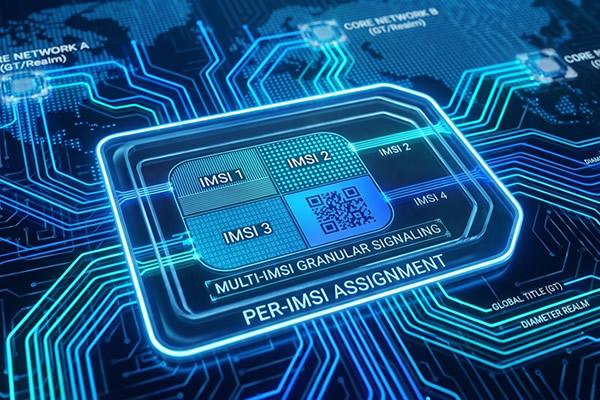
Advanced Multi-IMSI Signaling with Summa Networks: Per-IMSI Global Title and Diameter Realm Assignment
As mobile networks evolve towards more dynamic and distributed architectures, multi-IMSI SIM deployments are becoming increasingly common. These configurations enable greater flexibility for operators, but they also introduce new challenges at the signaling level—particularly when different IMSIs are associated with distinct core network identities.
One of the most critical challenges arises when each IMSI is tied to different HLR/HSS instances that operate with different Global Titles (GTs) and Diameter realms. In such scenarios, ensuring correct signaling, routing, and interoperability across networks becomes significantly more complex.
The Challenge of Signaling in Multi-IMSI SIM Deployments
In traditional network architectures, signaling parameters such as Global Title (for SS7/MAP) and Diameter realm (for LTE/IMS signaling) are typically defined at a node or network level. This approach assumes a one-to-one relationship between subscriber identity and signaling identity.
However, this assumption breaks down in multi-IMSI environments.
Each IMSI within a SIM may:
- Belong to a different operator profile
- Be anchored in a different HLR or HSS
- Require distinct signaling identifiers (GT and Diameter realm)
Without the ability to differentiate signaling parameters per IMSI, operators may face:
- Incorrect routing of MAP or Diameter messages
- Interoperability issues across legacy and IP-based networks
- Increased operational complexity and troubleshooting overhead
A Flexible Approach: Per-IMSI Global Title and Realm Configuration
To address these challenges, a more advanced signaling model is required—one that enables independent configuration of signaling identities at the IMSI level.
Summa Networks provides this capability by enabling:
Per-IMSI assignment of Global Title and Diameter realm
This means that for each IMSI within a multi-IMSI SIM:
- A specific Global Title can be defined and advertised to the SS7 network
- A specific Diameter realm can be assigned for LTE and IMS signaling
This granular approach ensures that each IMSI is correctly represented within the network, regardless of differences in backend core infrastructure.
How Per-IMSI Signaling Works
The solution dynamically applies signaling parameters based on the active IMSI being used by the subscriber.
When signaling is initiated:
- The system identifies the active IMSI
- It maps that IMSI to its corresponding:
- Global Title (for SS7/MAP signaling)
- Diameter realm (for LTE/IMS procedures)
- Signaling messages are generated and routed using these IMSI-specific identifiers
This ensures accurate signaling behavior across both SS7 and Diameter domains, enabling seamless interaction with multiple HLR/HSS instances.
Key Benefits for Operators and Network Architects
Enabling per-IMSI Global Title and Diameter realm assignment provides several operational and architectural advantages:
- Improved interoperability across multi-vendor and multi-core environments
- Accurate signaling routing for each IMSI, avoiding misrouting issues
- Support for complex multi-IMSI SIM strategies without network constraints
- Reduced operational complexity through more precise signaling control
- Seamless integration between legacy (SS7) and IP-based (Diameter/IMS) networks
This capability is particularly valuable in scenarios involving:
- Multi-operator agreements
- Global connectivity solutions
- Distributed or hybrid core network architectures
A Differentiating Capability in Modern Core Networks
While multi-IMSI support is becoming more common, not all solutions provide the level of granularity required to manage signaling identities at the IMSI level.
The ability to assign Global Title and Diameter realm per IMSI represents a key differentiator, enabling:
- Greater flexibility in network design
- More efficient multi-core integration
- Future-proof support for evolving deployment models
This reflects a broader shift towards modular and flexible core network architectures, where signaling behavior is no longer rigid but dynamically adapted to each subscriber identity.
Conclusion
As multi-IMSI deployments continue to grow in relevance, signaling architectures must evolve to support greater levels of flexibility and precision. Static, network-wide configurations are no longer sufficient in environments where a single SIM can represent multiple network identities.
Enabling per-IMSI Global Title and Diameter realm assignment addresses a critical gap in current implementations, allowing each subscriber identity to be accurately represented and routed within both SS7 and Diameter domains.
This capability not only simplifies interoperability with multiple HLR/HSS instances, but also provides operators with the control needed to scale multi-IMSI strategies without introducing additional signaling complexity.
Ultimately, this approach reflects a broader evolution in core network design—moving towards granular, software-driven adaptability, where signaling can be precisely aligned with the requirements of each individual IMSI.